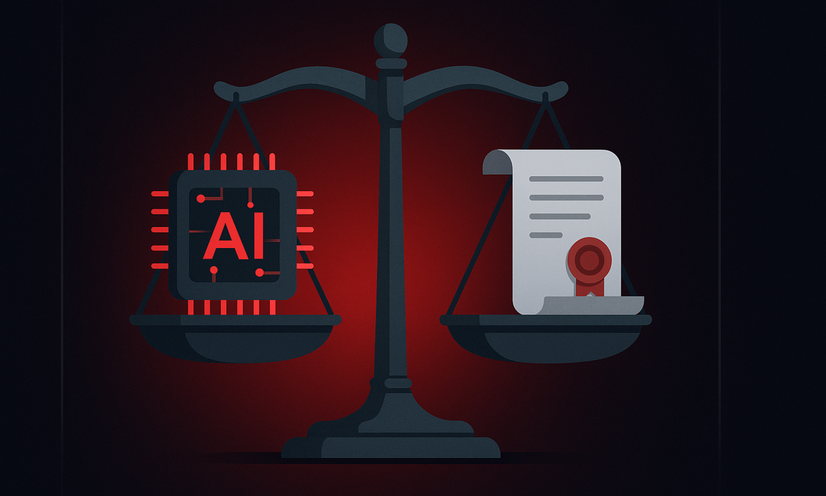
Six AI companies signed a voluntary safety pact with the White House on September 29, 2026. President Trump signed the White House Accord on Super Intelligence with leaders of Anthropic, OpenAI, Google, Nvidia, Meta, and xAI.
The accord asks each company to adopt four layers of controls and audits through internal teams, external auditors, and board oversight. The pact creates no regulator and carries no penalties.
The signing drew headlines as a milestone in federal AI oversight, but for enterprises that deploy these models, the White House AI safety accord changes little about AI risk management. The pact asks providers to govern their own models; it says nothing about the organizations running those models in production. If an AI system leaks data, discriminates, or commits the business to something unauthorized, the deploying organization still answers.
This article breaks down what the accord actually requires, where deployer liability still sits, and the practical steps security, legal, and compliance leaders should take now.
Key takeaways
- The voluntary accord creates oversight expectations, not enforceable protections: Its four-layer structure relies on provider self-regulation without a regulator, penalties, or mandatory publication of audit findings.
- Deployers still bear the consequences of AI behavior: Provider terms, the absence of a liability shield, and the Air Canada chatbot decision reinforce enterprise responsibility for harmful outputs and unauthorized actions.
- Existing legal duties remain fully relevant: State AI laws, the EU AI Act, DORA, HIPAA safeguards, and SEC disclosure requirements remain in force regardless of the federal pact.
- Enterprise control requires visibility and runtime enforcement: Leaders should identify AI applications, agents, and MCP servers, then apply intent-aware safeguards as interactions happen.
White House AI safety accord provisions
The White House Accord on Super Intelligence is a one-page, voluntary agreement signed September 29, 2026, by President Trump and the leaders of six AI companies. The signatories were Google CEO Sundar Pichai, Anthropic CEO Dario Amodei and Meta CEO Mark Zuckerberg.
OpenAI President Greg Brockman, xAI CEO Elon Musk and Nvidia CEO Jensen Huang also signed. President Trump called it “morally binding” with “a tremendous self-policing aspect.”
The accord describes four oversight layers:
- The first layer uses internal controls to monitor model capabilities and alignment during training and deployment.
- The second layer is an internal team that oversees those controls.
- The third layer uses independent external auditors or evaluators for review outside the internal team.
- The fourth layer is a board-level committee that reviews the auditors’ or evaluators’ reports.
The layers create a review structure, but the document creates no regulatory or legal penalties and doesn’t require companies to publish audit results.
The language throughout is advisory rather than mandatory. A single lead-in frames all four layers as what each company should implement, and the only forward-looking commitment is a pledge to meet regularly on shared safety standards and best practices.
You Can’t Secure What You Can’t See
WitnessAI gives you network-level visibility into every AI interaction across employees, models, apps, and agents. One platform. No blind spots.
Explore the PlatformWhy a voluntary AI pact leaves enterprises holding the risk
Voluntary AI commitments by model providers don’t move legal exposure away from the companies that deploy those models. Three factors keep deployers on the hook: the accord has no enforcement mechanism, provider contracts already assign responsibility downstream, and existing laws still apply to AI behavior.
1. The accord binds no one, and no one is shielded from liability
The accord lacks an enforcement mechanism and doesn’t assign accountability when a company falls short. Unlike CFIUS agreements, where “somebody is on the hook,” the first “real teeth” for any slowdown may come from the courts.
Treasury Secretary Scott Bessent told CNBC on September 21, 2026, that AI labs should not expect a “liability shield.” He added that responsibility belongs to humans, not AI.
2. Accountability for AI use stays with the deployer
Responsibility for prompts, outputs, and agent actions typically remains with the deploying organization. Provider terms commonly put this in writing. Google’s Gemini API terms, for example, state that for agentic services “you are solely responsible for the actions and tasks performed by the service.”
In Moffatt v. Air Canada, decided February 14, 2024, a British Columbia tribunal held the airline liable for its chatbot’s misstatement about bereavement fares. The tribunal called the argument that the chatbot was a separate legal entity “a remarkable submission.”
3. State, federal, and global rules are still in motion
The White House AI safety accord doesn’t preempt existing rules.
- At the federal level, the White House’s March 20, 2026 national AI policy framework called on Congress to preempt state AI laws. The framework “does not create immediate compliance obligations,” so state laws stay operative unless Congress acts.
- At the state level, Colorado’s SB 26-189 and New York’s frontier-developer RAISE Act both take effect January 1, 2027. These laws remain in motion independently of the accord.
- In the EU, the AI Act’s Article 50 transparency obligations have applied since August 2026, and the AI Omnibus moved high-risk deployer duties to December 2, 2027 for Annex III systems. Additional sector rules include financial-sector resilience under DORA, the HIPAA Security Rule’s safeguards, and the SEC’s four-business-day cyber incident disclosure rule.

What Does AI Compliance Look Like?
WitnessAI automatically logs every AI interaction, masks sensitive data in real time, and enforces regulatory policies across every region and business line. Audit-ready from day one.
See WitnessAI For ComplianceHow to translate the accord into a defensible enterprise program
The accord gives you a public reference point for what “good” governance looks like at the frontier labs. The practical move for enterprise leaders is to borrow that structure for your own program and close the gaps the accord doesn’t address. The four steps below focus on where deployer liability actually gets set.
1. Rewrite the vendor paper trail before the next model upgrade
The accord is silent on contracts, which is where deployer exposure actually gets set. Pull every active AI vendor agreement, model API terms of service, and reseller contract into one review and look for four specific clauses:
- Indemnification scope for model outputs
- Allocation of liability for agent actions
- Data use and training rights on your prompts
- The vendor’s own commitments to the accord’s four oversight layers
Most standard terms (Google’s Gemini API language is the clearest example) put agent behavior squarely on the customer. Where that’s the case, document it so your legal and finance teams aren’t surprised when an incident surfaces.
Where a vendor has publicly signed the accord, ask them in writing which of the four layers they’ve implemented, who the external auditor is, and whether the board committee’s findings are shareable under NDA. Treat the answers as a procurement input, not a marketing exercise.
2. Name an accountable owner for every AI use case
The accord assigns oversight to a board committee at each lab. Mirror that at the use-case level. For each production AI system (customer-facing chatbot, internal copilot, agentic workflow, embedded model in a SaaS tool) assign a single named owner who answers for its behavior, the data it touches, and the controls around it. CISOs tend to inherit this by default; it’s more defensible when it sits with the business owner who approved the use case, with security and legal as named reviewers.
A one-page accountability sheet per system (owner, approved use, data classes, model and version, controls, incident contact, last review date) gives you something concrete to show an auditor and forces conversations about systems nobody wants to claim.
3. Run a tabletop exercise on the specific scenarios the accord doesn’t prevent
Reading the accord tells you what model providers will self-police. A tabletop exercise tells you what happens on your side when self-policing fails. Pick three scenarios the accord does nothing to address and walk your incident response, legal, communications, and business teams through each:
- An agent executes an unauthorized action (refund, trade, contract commitment) based on a prompt injection in an inbound email.
- A customer-facing chatbot gives advice that contradicts your published terms, mirroring the Air Canada fact pattern.
- A regulator asks for a complete record of every prompt and response involving a specific customer over the past 12 months, with 10 business days to produce it.
The point isn’t to generate a report. It’s to find out whether you can actually answer the “who approved it, who ran it, what did it do, how do we know” questions in a defensible timeframe. Most organizations discover the gap is in evidence, not controls.
4. Decide now what you’ll publish, and what you won’t
The accord doesn’t require signatories to publish audit results, and that’s drawn criticism. Enterprises face a related choice: how much of your own AI governance posture do you disclose to customers, partners, regulators, and the board? Customers in regulated sectors are starting to ask for AI-specific attestations the way they ask for SOC 2 reports. Boards want a quarterly view that doesn’t require a translator.
Draft the two artifacts you’d want ready if asked tomorrow: a customer-facing summary of how you govern AI use (one page, no jargon) and a board-level dashboard that tracks AI inventory, policy violations, incident counts, and audit coverage. Deciding what goes in each forces the harder question of what you actually measure, and surfaces the metrics worth investing in.
Automating Compliance Before the Deadlines: The WitnessAI POV
While the White House AI safety accord is voluntary and carries no penalties, enterprise compliance teams are staring down hard operational deadlines. State laws like Colorado’s SB 26-189 and New York’s RAISE Act take effect on January 1, 2027, and EU AI Act transparency rules are already live.
Waiting months to deploy endpoint agents or relying on manual GRC spreadsheets leaves organizations exposed. WitnessAI’s core point of view is that enterprise AI governance must be automated, real-time, and friction-free:
- Instant, Zero-Agent Discovery: You cannot secure what you don’t see. Rapid deployment relies on network-level observation to instantly discover every shadow AI app, employee-used copilot, agentic framework, and Model Context Protocol (MCP) path in your tenant without waiting for endpoint rollouts.
- Runtime Policy Enforcement: Compliance is proven through verifiable runtime action, not static policy documents. Deploying automated allow/warn/block/redact guardrails ensures sensitive data is protected and unauthorized agent actions are intercepted instantly as interactions occur.
- Audit-Ready Evidence by Default: Automatically logging prompts, responses, human-to-agent attribution, and policy outcomes provides the exact granular audit trail required by boards and regulators from day one.
By shifting from manual oversight to automated AI Usage Control, security and compliance leaders can turn regulatory pressure into a defensible operational advantage before enforcement deadlines arrive.