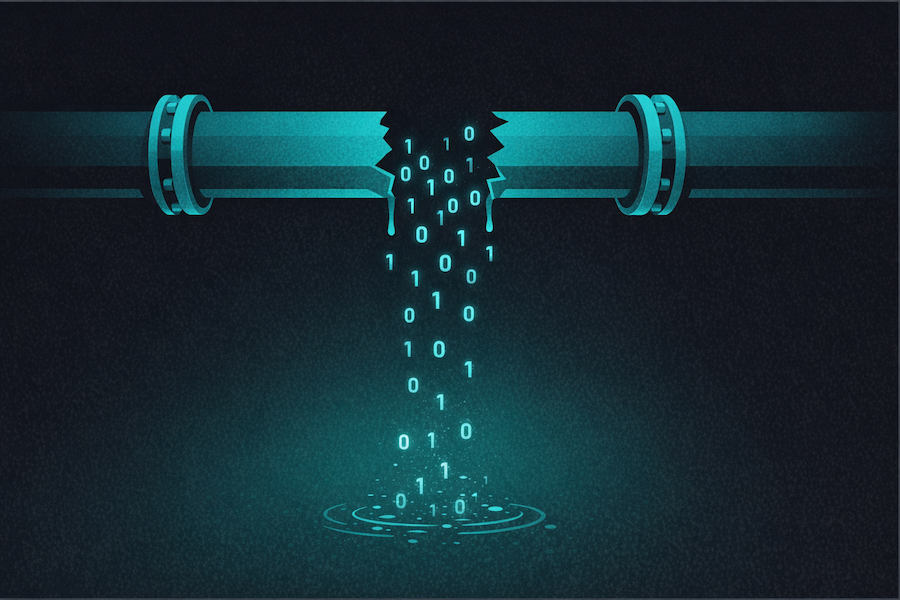
As employees routinely use AI tools to debug code, analyze data, and automate workflows, AI data leaks have become a major risk category in enterprise security.
Organizations with formal AI policies have some measure of visibility and control over these interactions. But even with policies in place, shadow AI remains a persistent exposure. In fact, in 2025, 20% of organizations that suffered a data breach said the security incidents involved shadow AI.
Whether the AI usage is sanctioned or shadow, the underlying risk is the same: sensitive data flowing into systems without adequate visibility, classification, or control. This guide covers what AI data leaks are, which data is most at risk, how they occur in practice, what they cost, why traditional security tools miss them, and how to prevent them.
Key Takeaways
- AI data leaks are a distinct risk category that differs from traditional breaches in mechanism, detection, and impact.
- These leaks can occur at any point in the AI lifecycle, from model training to production use.
- Traditional security tools depend on data labels, keyword matching, and browser-level visibility; none of which apply to AI-powered workflows.
- Prevention requires a purpose-built approach that combines full AI usage visibility, intent-based machine learning, data tokenization, and runtime security for models.
What Is an AI Data Leak?
An AI data leak occurs when confidential, proprietary, or regulated information is exposed through an AI system in ways the organization didn’t intend and can’t control. The exposure can flow in any direction: employees sending sensitive data to external AI services, AI models revealing memorized training data in their outputs, or autonomous agents exfiltrating information through tool access and API calls.
These leaks are hard to catch because they don’t behave like traditional data breaches, and the tools built to stop traditional breaches weren’t designed for them. To understand why, it helps to look at how AI data leaks differ from conventional exfiltration in three fundamental ways:
- AI introduces entirely new attack mechanisms, like prompt injection, training data extraction, and inference-time leakage, that can bypass conventional controls without triggering any alerts.
- Detection requires understanding context and intent, rather than scanning for structured labels.
- LLMs are probabilistic systems that can produce different outputs from identical inputs. So, they create a threat surface that deterministic security tools were never built to monitor.
These structural differences explain why existing Data Loss Prevention (DLP), Cloud Access Security Broker (CASB), and Security Service Edge (SSE) solutions consistently fail against AI data leaks. For example, when data is vectorized for retrieval-augmented generation, it becomes mathematical representations that DLP can’t inspect at all. So, effective protection requires visibility and control at the point of interaction, not just at rest or at the network perimeter.
The AI Data Leak Lifecycle
AI data leaks can occur at every phase of the AI lifecycle, but the risk distribution isn’t evenly weighted.
- Training phase. Models can memorize sensitive information from their training datasets, and those memorized sequences can sometimes be extracted under certain conditions.
- Inference phase. Inference-time exposure can happen through employees sharing confidential information in prompts, models returning sensitive details in responses, or data lingering in context windows across sessions.
- Deployment phase. When organizations deploy AI models or connect them to internal systems, misconfigured access controls can expose sensitive data to anyone who can reach the model.
- Usage phase. This is the broadest attack surface, encompassing every employee interaction with every AI tool, every coding assistant suggestion, and every autonomous agent action.
Enterprises that focus their security investment primarily on training-phase risks while ignoring inference- and usage-phase exposure are defending only half of the perimeter.
How AI Data Leaks Happen in Enterprises
People use AI to get their jobs done faster, and in doing so, can potentially share data that the organization would rather not expose. That’s what makes AI data leaks so dangerous, and why traditional security tools, built to catch malicious exfiltration, consistently miss them.
1. Employees Pasting Sensitive Data Into Public AI Tools
The most common vector is also the most mundane: employees copying confidential information into public AI tools to work faster.
- Support teams paste PII and customer records when summarizing tickets.
- Analysts share financial data and deal terms when running queries.
- Legal and strategy teams upload board-level communications and M&A documents for summarization. This content is sensitive because of its context, not because it contains keyword triggers.
Also, employees frequently paste real company information, including sensitive content, into external chatbots, often through personal accounts or unapproved tools. And because these interactions look like normal productivity rather than exfiltration, traditional DLP rarely flags them.
2. Source Code and IP Leaking Through AI Coding Assistants
Coding assistants create a more concentrated version of the same problem: they process proprietary code by design, often with broad repository access, making IP leakage a feature of the workflow rather than an accident.
Every debugging session, refactoring request, and code review can expose proprietary source code and trade secrets. Developers also routinely paste code containing hardcoded API keys, credentials, and secrets into AI assistants, creating immediate operational exposure on top of the IP risk.
Cloud-based AI agents compound the problem by generating code that bypasses IDE-level security scanning entirely. The result: the tools developers rely on most are also the tools least visible to security teams.
3. AI Models Memorizing and Exposing Training Data
Large language models can memorize portions of their training data, and that memorization can be exploited through extraction attacks.
When organizations fine-tune models on sensitive enterprise data (customer records, source code, financial details, strategic documents), they embed that data permanently in model weights, creating a leak vector that no perimeter tool can inspect or control.
For most enterprises, the practical risk is the downstream consequence of fine-tuning without adequate output filtering.
Traditional DLP can’t inspect model weights or determine which sensitive data the model has memorized, meaning this vector is invisible to the same tools organizations already depend on.
4. Agentic AI Exfiltrating Data Through Tool Access and MCP Servers
If vectors one through three show that employee productivity drives AI leakage, this one shows the same problem is about to get faster, broader, and harder to detect as agentic adoption scales.
Employees drive the first three vectors. Agentic AI exfiltration is driven by software that operates independently. Autonomous agents call APIs, query databases, access file systems, and interact with external services through the Model Context Protocol (MCP), often with broader permissions than any individual employee. That means every data category covered above — PII, source code, credentials, financial records, confidential communications — can be accessed, combined, and sent externally in a single workflow, at machine speed, with no human in the loop.
MCP makes the problem worse. The protocol contains a critical architectural limitation: it doesn’t inherently carry user context, so the server can’t differentiate between users and may grant identical access to everyone. Improperly configured, agents behave like an insider threat with privileged access. The difference is that they operate continuously, at scale, and outside the user-interface controls that traditional security tools depend on.
The Real-World Cost of AI Data Leaks
AI data leaks carry financial, regulatory, and reputational costs that are now quantifiable. The gap between organizations that govern AI usage and those that don’t is widening across all three.
1. Breach Cost
The global average breach cost was $4.44 million in 2025, and for organizations with high levels of shadow AI, breaches cost an additional $670,000. That positions shadow AI as one of the top three costliest breach factors, displacing the security skills shortage from prior years.
Shadow AI incidents disproportionately compromised customer PII (65% vs. 53% global average). Breaches involving shadow AI were also more likely to result in the compromise of intellectual property (40%).
And the governance gap behind these numbers is wide: 63% of breached organizations either don’t have an AI governance policy or are still developing one, and of those that do, only 34% perform regular audits for unsanctioned AI.
2. Regulatory Penalties
Regulators have moved from issuing guidance to imposing consequences. The EU AI Act can penalize prohibited AI practices up to €35 million or 7% of global revenue.
The Italian Data Protection Authority has already issued an AI-specific penalty against OpenAI, signaling that enforcement is live, not hypothetical.
For financial entities, DORA imposes up to 2% of global turnover, plus €1 million in personal liability for senior management
The compounding risk is what matters most here. A single AI data leak involving customer PII can trigger multiple regulatory regimes simultaneously. The routine employee behavior described above becomes a multi-jurisdictional compliance event, and the penalties stack.
3. Brand Damage
65% of data breach victims report a loss of trust in the breached organization, and 80% of consumers in developed countries say they’ll abandon a business if their personal information is compromised. Consumer comfort with AI sits at just 44% globally, and that’s before something goes wrong. Once it does, the damage compounds fast.
Recovering loyalty can take months or even years. For AI-related incidents specifically, consumers seem less forgiving toward data breaches by companies in newer industries, which is exactly where AI-driven organizations sit.
AI also introduces a reputational risk that traditional breaches don’t: customer-facing chatbots that can be manipulated to say things the brand would never sanction. When a chatbot generates harmful, offensive, or inaccurate content under your brand name, the reputational fallout is immediate and public. No amount of post-incident explanation changes the screenshot that’s already circulating.
The flip side is just as clear: more than three in four consumers expressed willingness to pay premium prices for companies with verified AI data practices. That makes trust a monetizable differentiator. Organizations that demonstrate governance gain revenue advantage, while those that lose it face a recovery that’s slower and harder than any technical remediation.
How to Prevent AI Data Leaks
Preventing AI data leaks requires a layered approach that spans policy, visibility, classification, inline protection, agent governance, and audit. The following framework addresses each layer in sequence, from organizational foundations to technical enforcement.
1. Establish an AI Acceptable Use Policy
An AI use policy is the organizational baseline that defines which AI tools are permitted and which are prohibited. It also establishes data classification boundaries, documents acceptable use cases, and clarifies enforcement mechanisms.
Without enforcement mechanisms, such as automated policy controls and real-time monitoring, an AI use policy becomes guidance that employees can ignore, and shadow AI continues unchecked.
2. Gain Full Visibility Into AI Usage Across Every Surface
If enterprises can’t see data flowing into AI systems, they can’t protect it. Visibility must extend across browsers, native desktop applications, coding assistants, embedded copilots, autonomous agents, and MCP server connections.
WitnessAI, a unified AI security and governance platform, addresses this visibility gap through network-level visibility that operates without endpoint clients, browser extensions, or SDK modifications. Here’s how the platform’s three core modules map to the prevention workflow:
- Observe: Network-level visibility and discovery across AI apps, agents, and MCP connections.
- Control: Intelligent policies enforced with intent-based machine learning engines, plus audit trails and attribution.
- Protect: Runtime security with bidirectional defense, including data tokenization, pre-execution protection, and response protection.
Additionally, Witness AI offers automated red teaming to harden models and agentic workflows prior to deployment.
3. Classify by Intent, Not Just by Tool or Data Label
Traditional classification methods rely on keyword matching, regular expressions, and predefined data labels to flag sensitive content. But AI interactions are conversational and contextual — the same words can be harmless in one scenario and a policy violation in another. Intent-based classification addresses this gap by analyzing what the user is trying to accomplish rather than just what words appear in the prompt.
Intent-based machine learning engines make this possible at scale. Rather than scanning for static patterns, custom models evaluate conversational context, user behavior patterns, and semantic meaning to determine whether an interaction poses a real risk.
For example, a CFO analyzing publicly available financial data shouldn’t trigger the same policy as an employee sharing quarterly earnings before disclosure. The underlying data may look similar, but the intent — and the risk — are fundamentally different. Intent-based classification is what allows security teams to distinguish between the two.
4. Protect Data Inline With Real-Time Tokenization
Sensitive data must be protected before it reaches third-party AI models — but blocking AI interactions entirely defeats the purpose. The challenge is neutralizing exposure without destroying the utility of the workflow.
Data tokenization solves this by replacing sensitive information, such as Social Security numbers, credit card numbers, and API keys, with tokens that preserve workflow functionality while ensuring raw data never leaves the organization’s control boundary.
But tokenization only covers the outbound side of the interaction. Response protection completes the cycle by inspecting model outputs before they reach users and rehydrating tokenized values only when policy allows. Together, these two mechanisms create a bidirectional defense that keeps data protected in both directions.
5. Extend Governance to AI Agents and Autonomous Workflows
Autonomous agents that call APIs, query databases, and execute multi-step workflows operate with privileged access and lack traditional security boundaries. Unlike employee-driven AI usage, these agents act independently, often chaining together multiple tools and data sources in a single workflow without human oversight.
That level of autonomy demands a corresponding level of governance. AI agent governance must treat autonomous agents with the same rigor applied to privileged human users, including zero-standing privileges, dynamic credential provisioning, and human-in-the-loop approval for high-risk operations.
In practice, agentic runtime security needs two checkpoints:
- Pre-execution protection: Inspect prompts, tool requests, and tool-call intent before taking an action.
- Response protection: Inspect the agent’s outputs and downstream effects before they’re delivered or committed.
WitnessAI extends governance to both human and digital workforce activity through unified policy enforcement, tool-call protection, and bidirectional monitoring.
6. Build an Immutable Audit Trail for Every AI Interaction
An audit trail capturing both prompts and responses, across human and agent activity, enables organizations to demonstrate compliance with the EU AI Act, GDPR, and DORA.
Most legacy approaches fall short here. They capture only that an AI tool was accessed — not what was said to the model or what the model returned. Without capturing the full interaction in both directions, organizations can’t prove what data was returned, whether harmful content was generated, or whether interactions violated policy.
Close the Gap Between AI Adoption and AI Governance
AI data leaks are fundamentally a governance issue, but they can be solved by building governance into how AI is used from the start.
WitnessAI provides security and AI teams with a shared framework to observe, control, and protect all AI activity across their human and digital workforce. The platform delivers this through intent-based machine learning engines, bidirectional visibility, data tokenization, and runtime defense delivered through runtime guardrails.
With 99.3% true-positive guardrail efficacy, SOC 2 Type II certification, and validation from organizations including a Global Top 5 Airline and InComm Payments, WitnessAI provides the visibility and control enterprises need to demonstrate AI governance to regulators and boards, and to accelerate AI projects with confidence.