
What is AI Monitoring?
AI monitoring refers to the continuous oversight of artificial intelligence systems, models, and workflows to ensure optimal performance, data integrity, and secure operation throughout their lifecycle. It includes tracking real-time metrics, detecting anomalies, identifying model drift, and measuring outputs against predefined thresholds to maintain reliability and compliance.
AI monitoring systems span across machine learning (ML) pipelines, generative AI platforms, and large language models (LLMs), providing deep observability into how these systems function and evolve. This enables organizations to catch deviations from expected behavior, optimize workflows, and ensure that AI models remain aligned with business and ethical standards.
Why AI Monitoring is Crucial for Successful AI Implementation
Implementing AI systems without robust monitoring is akin to flying an aircraft without an instrument panel. You might stay airborne for a while, but eventually, unmonitored latency, pipeline bottlenecks, or unexpected behaviors will degrade performance or cause failure.
Key reasons AI monitoring is critical include:
- Ensuring Accuracy: AI models degrade over time due to changing data patterns (model drift). Monitoring helps validate that predictions remain accurate in real-world applications.
- Maintaining Trust: Monitoring supports explainability, allowing stakeholders to understand how and why AI systems make decisions.
- Meeting Compliance: Monitoring enables alignment with regulatory frameworks around sensitive data use, especially in sectors like healthcare, finance, and security.
- Preventing Failures: Real-time anomaly detection and root cause identification prevent small issues from becoming systemic problems.
With effective AI monitoring, enterprises can confidently deploy AI systems in production environments and scale them across complex workflows.
How Does AI Monitoring Improve AI Performance?
Monitoring systems provide actionable insights into model performance by continuously tracking input data, model behavior, and output quality. Here’s how it helps optimize AI performance:
- Real-Time Metrics Collection: AI monitoring tools gather and display key performance indicators (KPIs) such as accuracy, precision, recall, and inference time on interactive dashboards.
- Performance Tuning: By identifying latency spikes, data ingestion issues, or underperforming algorithms, teams can refine hyperparameters or retrain models proactively.
- Detecting Model Drift: Continuous monitoring surfaces subtle changes in input data or output distribution, alerting teams to potential model drift before it impacts users.
- Automated Workflows: Many modern systems offer AI-powered or automated responses to detected issues, such as flagging anomalies or rolling back models that fail validation checks.
Monitoring ensures that AI systems meet their expected objectives under varying workloads.
How Does AI Monitoring Improve Data Security?
As AI systems increasingly rely on sensitive data to train and generate outputs, securing these data pipelines becomes critical. AI monitoring strengthens data security through:
- Anomaly Detection: Identifies suspicious access patterns, unusual inference behavior, or attempts to exploit vulnerabilities in generative AI models.
- Policy Enforcement: Tracks adherence to data access policies, ensuring that PII and other sensitive data are only used within authorized boundaries.
- Audit Trails: Monitoring tools record detailed logs of input, output, and model interactions for forensic investigations and compliance audits.
- Deviations Monitoring: Detects unexpected changes in data quality, schema, or source systems that could indicate data poisoning or tampering attempts.
By continuously scanning for potential issues in data ingestion, processing, and decision-making, monitoring systems help maintain both the integrity and confidentiality of enterprise AI operations.
Is AI Monitoring Scalable for Large Organizations?
Yes, modern AI monitoring frameworks are designed for scalability across large organizations with complex AI ecosystems. Scalability features include:
- Multi-Model Support: Monitor hundreds or thousands of models in parallel, from predictive analytics to generative LLMs.
- Distributed Architecture: Tools are often built on distributed systems to support high-throughput workloads and low-latency environments.
- Integration Capabilities: Leading platforms offer APIs to integrate seamlessly with CI/CD pipelines, model registries, and real-time dashboards.
- Federated Monitoring: Global enterprises can implement federated systems that track AI performance and compliance across regions and cloud environments.
AI monitoring integrations and solutions tailored for enterprises can provide both depth and breadth in observability.
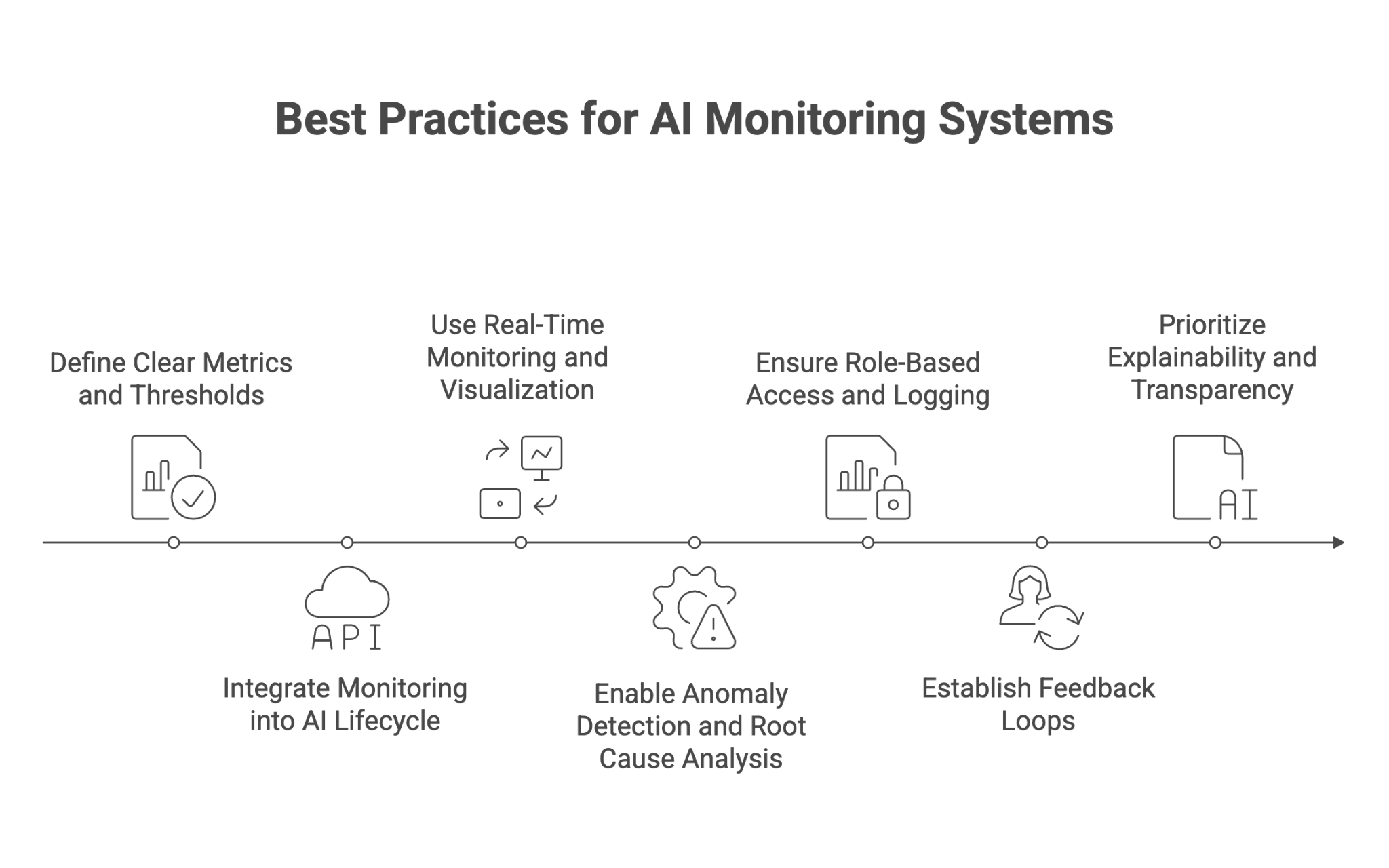
What Are the Best Practices for Implementing AI Monitoring Systems?
To build an effective AI monitoring strategy, organizations should follow these best practices:
1. Define Clear Metrics and Thresholds
- Identify performance, accuracy, latency, and fairness indicators.
- Establish acceptable thresholds to trigger alerts when exceeded.
2. Integrate Monitoring into the AI Lifecycle
- Embed monitoring from data ingestion and model training through to deployment and retirement.
- Align monitoring checkpoints with model validation and retraining cycles.
3. Use Real-Time Monitoring and Visualization
- Deploy tools that support real-time alerting and dashboard visualization to surface actionable insights quickly.
4. Enable Anomaly Detection and Root Cause Analysis
- Use AI-powered systems to automate troubleshooting and classify issues by source (data, model, infrastructure).
5. Ensure Role-Based Access and Logging
- Protect sensitive logs and dashboards with access controls.
- Maintain immutable logs for compliance with auditing requirements.
6. Establish Feedback Loops
- Create pipelines that use monitoring data to trigger model retraining or adjustments.
- Involve domain experts and end-users to validate flagged outputs and improve monitoring precision.
7. Prioritize Explainability and Transparency
- Use explainable AI techniques to provide insight into flagged events or deviations.
- Document AI decisions and monitoring logic to ensure stakeholder alignment.
AI monitoring isn’t just a technical necessity—it’s a business enabler. By embedding continuous, automated, and scalable oversight into their AI applications, enterprises can ensure that their systems remain secure, compliant, and high-performing in real-world use cases.
About WitnessAI
WitnessAI is the confidence layer for enterprise AI, providing the unified platform to observe, control, and protect all AI activity. We govern your entire workforce, human employees and AI agents alike, with network-level visibility and intent-based controls. We deliver runtime security for models, applications, and agents. Our single-tenant architecture ensures data sovereignty and compliance. Learn more at witness.ai.