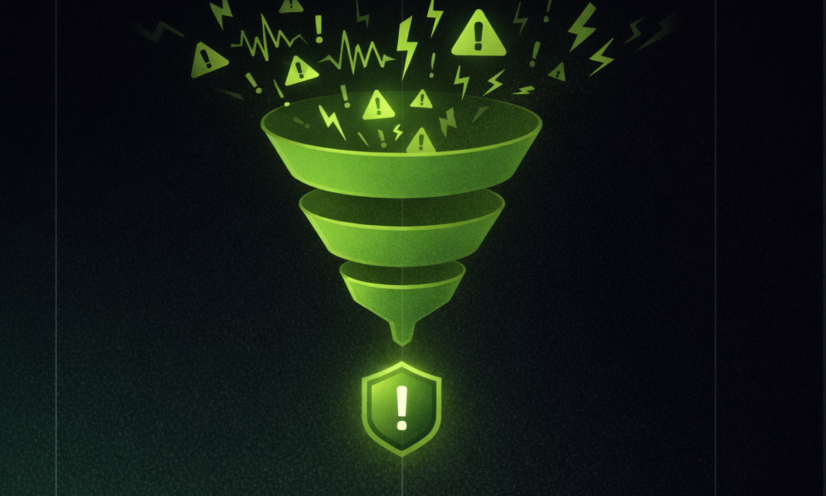
Security operations teams can expand investigations without adding equivalent analyst headcount. In simulated SOC environments, agentic AI has reduced false-positive load and response time by enriching alerts, suppressing noise, and accelerating low-risk case handling before an analyst opens a ticket.
That speed creates a governance challenge for security and risk leaders. The same autonomous capability that compresses detection and response also needs controls against misdirection, excessive permission, and unmanaged replication across teams.
Threat detection improves when agentic AI runs inside a control framework. Security teams need visibility into agent activity, policy tied to intent, and runtime defense before agent actions execute.
Key takeaways
- Agentic AI differs from generative AI in that it can plan, act, and influence real-world systems with limited human intervention.
- In threat detection, agentic AI can reduce false positives, accelerate response, support multi-agent investigations, and continuously monitor behavioral anomalies.
- The same autonomy that improves detection also introduces risks such as prompt injection, excessive agency, credential abuse, shadow agent sprawl, and untracked MCP connections.
- Many legacy governance and data protection approaches struggle with AI-native risks because they rely on static rules and lack the context and intent awareness needed for AI interactions.
- Safe agentic detection requires discovery, intent-based policy, runtime guardrails, and unified governance across human users and autonomous agents.
What is agentic AI in the context of threat detection
Agentic AI is software that plans, acts, and pursues a mission across systems with limited human direction. For threat detection, that means agents that investigate and respond on their own clock, not on the analyst’s.
Forrester describes agentic AI as one or more AI agents that operate with limited human intervention, learn from feedback and inputs, and work toward a mission. This separates it from generative AI, which typically creates content in response to a prompt and then stops. Execution authority stays with the human user.
The structural relationship is worth holding onto. Generative AI can supply the reasoning layer. Agents are the frameworks that use that reasoning to perform actions across software environments. In a security operations center, that means an agent can ingest data from multiple sources, analyze it, form a plan, and act on indicators of compromise as they appear.
Depending on deployment design and permissions, an agent may be authorized to isolate a host or suspend a credential without direct analyst intervention. NIST has noted that AI agent systems can perform autonomous actions that affect real-world systems and environments. That’s why they present distinct security challenges.
For security teams, this shifts the focus from content to action. A generative system produces a remediation recommendation. An agentic system can execute the containment step. They can also amplify errors across delegation chains before human intervention. They may exhibit behavioral drift that crosses a critical threshold. Threat detection benefits from that autonomy, and the same autonomy increases the need for security, governance, and accountability controls.
How agentic AI actively improves enterprise threat detection
Agentic AI improves threat detection by closing the gap between human capacity and machine-speed attacks. The strongest gains often start with autonomous alert triage and extend into multi-agent investigation. Continuous behavioral monitoring adds coverage for threats that unfold over time.
Evidence is still emerging across different baselines and SOC maturity levels. Individual results should be treated as directional across current evidence. In one academic study, an LLM agent tested in simulated SOC environments halved false positives from 70% to 35%. The same study reduced MTTR from 8 hours to 90 minutes and increased the rate of automated ticketing from 10% to 75%.
Across these results, three capabilities account for most of the detection upside: autonomous alert triage, multi-agent investigation, and continuous behavioral monitoring.
1. Autonomous alert triage cuts false positives and frees analysts
When alert volume creates low-confidence queues, human analysts have limited capacity to investigate each signal manually. Agentic AI can handle much of that Tier-1 work autonomously by enriching alerts, suppressing false positives, and escalating cases that warrant human judgment.
Autonomous triage gives analysts more consistent investigation at scale. An agent can collect context, compare signals, check related activity, and make a first-pass determination before an analyst spends time on the case.
When tuned well, that lets experienced analysts focus on ambiguous, high-impact, or business-sensitive investigations while agents handle most repetitive triage.
2. Multi-agent architectures investigate at machine scale
A multi-agent design can divide investigation across specialized roles. Multi-agent designs can split incident response into roles such as intelligence synthesis, investigation, decision support, and orchestration. That structure links related events and ranks risk in ways a single analyst working sequentially may miss.
This matters because enterprise incidents rarely arrive as a single clean alert. They appear as weak signals spread across identity, endpoint, SaaS, cloud, and data systems.
A multi-agent architecture can assign separate agents to intelligence synthesis, evidence collection, correlation, and response orchestration. It can then consolidate the result into a ranked investigation path for the human analyst.
3. Continuous monitoring surfaces slow-moving behavioral threats
Threats that unfold over months require monitoring that sustains attention over that timeframe at an enterprise scale. Human teams are rarely staffed for that kind of workload.
Autonomous agents can monitor behavioral anomalies continuously and track how patterns shift across sessions. This is the same capability that makes agents useful for catching many insider threats and credential abuse. In those cases, activity may be technically authorized but behaviorally abnormal.
The detection signal often lives in behavioral deviation. Persistent monitoring is what tends to surface it.
4. Threat intelligence enrichment sharpens every alert in flight
Most alerts arrive with limited context, leaving analysts to pivot across feeds, sandboxes, and internal data sources before they can make a call. Agentic AI can help close that gap automatically by correlating indicators against external threat intelligence, dark web chatter, vulnerability databases, and historical incident data the moment a signal fires.
That enrichment changes the starting point of many investigations. Instead of opening a ticket with an IP address and a rule name, an analyst sees the actor profile, known TTPs, related campaigns, and prior internal sightings already attached.
Agents can also re-enrich open cases as new intelligence lands, so a finding that looked benign on Monday can be reclassified on Wednesday without anyone re-opening the ticket.
5. Adaptive response playbooks evolve with the attack
Many static playbooks assume the next incident will look like the last one. Agentic AI can challenge that assumption by selecting, sequencing, and adjusting response steps based on what the environment is actually telling it in the moment.
When an agent observes that a containment action didn’t fully scope the blast radius, it can pivot. It can pull additional telemetry, isolate adjacent identities, or escalate to a higher-tier playbook without waiting for a human to redraw the workflow. That adaptability matters most during fast-moving incidents like token theft or lateral movement. In those cases, each minute of delay tends to widen the impact.
Over time, the outcomes of those decisions can feed back into the agent’s behavior, so playbooks can improve with each incident instead of aging on a shared drive.
Detecting agents need visibility and runtime control so autonomous speed stays aligned with enterprise policy.
You Can’t Secure What You Can’t See
WitnessAI gives you network-level visibility into every AI interaction across employees, models, apps, and agents. One platform. No blind spots.
Explore the PlatformThe risks autonomous agents introduce to the enterprise
Many of the agents that detect threats can also become a liability. The same capabilities that make agentic AI useful for defense, such as autonomous action, access to tools, credential inheritance, and multi-step reasoning, can become an attack surface when an adversary turns them against the enterprise.
OWASP’s agentic guidance identifies agent-specific risks, including goal hijack, tool misuse, identity and privilege abuse, agentic supply chain vulnerabilities, and rogue agents. Three categories show up most consistently in enterprise deployments:
- Prompt injection can redirect trusted agents: Prompt injection attacks are among the most direct ways to manipulate an agent, and OWASP lists it as LLM01 in the OWASP Top 10 for LLM Applications. Indirect injection scales further because malicious instructions can be embedded in content the agent ingests, such as documents and emails.
- Excessive agency lets a compromised agent reach many systems: it occurs when an agent holds more functionality, permissions, or autonomy than its job actually requires. In practice, the credentials attached to those agents can become one of the highest-leverage attack paths in the modern enterprise. A single compromised token may reach dozens of integrated systems and persist long after the agent is decommissioned.
- Shadow agent sprawl and MCP connections create blind spots: Engineering and product teams may stand up agents that connect to tools, external APIs, and MCP servers the security team hasn’t scoped. The MCPTox benchmark observed tool-poisoning attack success rates of up to 72.8% across 45 live MCP servers, showing how quickly an unmapped connection can become exploitable.
The risks above make it clear that the same autonomy that powers agentic detection can also expand the attack surface. This is why governing agents require controls purpose-built for how they actually operate.

Knowing Which AI Tools Are in Use Is Just the Start
WitnessAI goes beyond app discovery. Observe classifies the intent behind every AI interaction across employees and agents, so you can build smarter policies based on real risk, not guesswork.
Explore ObserveThe AI risk management controls that make agentic detection safe
Capturing the detection upside of agentic AI requires a control framework that governs agents the way it governs employees. That framework starts with discovery and continues through policy enforcement when an agent acts.
The controls below align with the NIST AI RMF and OWASP agentic guidance and map directly to how AI risk management must operate when the workforce includes autonomous agents.
WitnessAI is a unified AI security and governance platform that helps Global 2000 organizations observe, control, and protect AI activity across both human employees and autonomous agents. Its modules line up against the three controls that matter most for safe agentic detection:
- Discovery and intent classification establish what agents are doing. Teams have to map agents before they can govern them across both sanctioned and shadow AI deployments. The WitnessAI Observe module uses network-level discovery to detect agentic sessions by analyzing tool advertisements in traffic payloads, identify the public and private MCP servers in use, and continuously catalog AI activity across browsers, native apps, developer tools, and IDEs.
- Intent-based policy enforcement governs agents by purpose, not keywords. Outright blocking stalls AI adoption, and Global 2000 organizations often have different legitimate requirements across teams. The WitnessAI Control module applies a four-action model — allow, warn, block, and route — and uses real-time data tokenization to help protect PII, credentials, and IP before content reaches a third-party model.Because the same governance framework applies to both humans and agents, organizations can maintain visibility into agent activity and its relationship to originating identities and workflows.
- Runtime guardrails enforce at the moment of action, before execution. Machine-speed attacks leave little room for post-execution review, and high-risk actions need human oversight before execution. The WitnessAI Protect module provides bidirectional runtime defense by inspecting prompts for prompt injection and jailbreak attempts and evaluating model responses against security, safety, and policy controls before delivery.
These three controls help shift agent oversight from periodic reviews to continuous runtime discipline.
Knowing Which AI Tools Are in Use Is Just the Start
WitnessAI goes beyond app discovery. Observe classifies the intent behind every AI interaction across employees and agents, so you can build smarter policies based on real risk, not guesswork.
Explore ObserveWhy unified governance of humans and agents is becoming essential
You should govern humans and AI agents as one integrated workforce under a single framework. Fragmented programs tend to break down at handoffs. If you’re the CISO presenting agent risk to the board, fragmented ownership is often the part that survives scrutiny the least.
When the CISO owns security risk, legal owns contracting, compliance owns regulatory requirements, and HR owns acceptable use, fragmented ownership weakens the outcome. Policies often remain unenforced. Decisions also stall when no single authority is positioned to approve or block a deployment.
The regulatory clock reinforces the need for unified governance: the EU AI Act’s high-risk AI system obligations phase in from 2 August 2026. That raises the importance of logging, traceability, and meaningful oversight.
A unified governance model applies consistent principles to humans and agents across identity, access, observability, and review. This is also where the AI Steering Committee earns its place. It brings security, legal, compliance, HR, and the business owners of each use case under shared visibility.
The committee sets direction and assigns accountability. The platform helps organizations apply governance and enforcement consistently across both human and agent workforces. It also gives the committee the visibility and audit trails needed to govern a digital workforce that’s often growing faster than directories can track.

Blocking AI Isn’t a Strategy. Governing It Is.
WitnessAI enforces intent-based policies, routes prompts to the right models, and redacts sensitive data in real time so your teams keep moving while your data stays protected.
Explore ControlMoving from agentic risk to agentic confidence
Agentic AI strengthens threat detection in measurable ways, but those gains hold only when the detecting agents are themselves governed. The same autonomy that compresses response time can be exploited through prompt injection and overprivileged or hidden agents.
The organizations capturing the upside are often the ones treating AI risk management as the organizing discipline. They make agent activity visible and govern actions by intent at runtime.
WitnessAI’s unified platform gives security and AI teams a shared framework to govern the autonomous agent workforce before an incident forces the conversation. The platform combines intent-based governance, runtime protection, and enterprise-wide visibility to help organizations govern both human and agent workforces at scale. For a closer look at your agentic deployments, book a demo.